

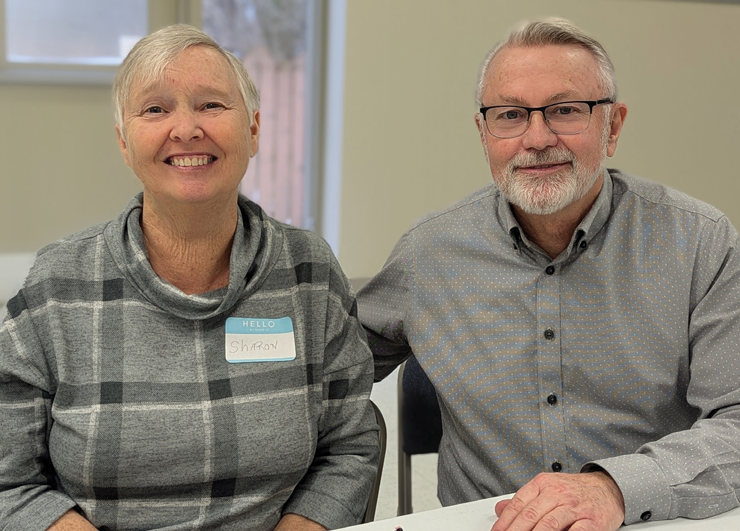
Sharon and Bill Bennett at a Memory Café, a social event for people with dementia and care partners that is hosted twice a month by the Alzheimer Society of Windsor and Essex County.
Bill Bennett
More than 770,000 Canadians live with dementia, a number that is expected to grow to almost one million by
2030. Every hour, about 17 Canadians develop this condition, with Alzheimer’s disease the most common cause.1
Bill Bennett’s wife of 47 years, Sharon, was diagnosed with dementia in 2022. Alongside raising three children
and now with six granddaughters, the couple spent decades training golden retrievers. In the last 10 years, they
participated in the St. John’s Ambulance Therapy Dog Program, taking a succession of three dogs to visit hospice
patients and severely disabled children. Their current dog, KayTee, is a companion dog for Sharon.
Bill has dedicated himself to giving
Sharon the best possible quality of
life, travelling together extensively
while she still could and ensuring she
has as many social activities as
possible — with family and friends
and with groups organized by the
Alzheimer Society. Still, it’s
undeniable that caregiving is a
tremendous strain: “I haven’t met
one care partner that’s doing well.
Not one,” he says.
The experiences Bill shares here
highlight some of the challenges he’s
faced, as well as opportunities
employers have to support
employees who are care partners.
How did finding out your wife has dementia affect you?
Sharon’s mother, two sisters and one of her two brothers had dementia, so we knew she might be susceptible. But knowing others who have dementia and actually living with dementia are two different situations. They are not comparable.
The metaphor I use is a jigsaw puzzle. If you think of your life as a jigsaw puzzle, as you get older you get more pieces and you put them together to form a picture of what your life has been and what it’s going to be like. Dementia takes that jigsaw puzzle and it tears corners off the pieces. It bends them. It distorts them. It removes pieces from the puzzle. Some come back into the wrong place. Some don’t come back at all. The end result is that finally, all the pieces will be removed. There will be no picture and there will be no puzzle. With Sharon, there are a few pieces of the puzzle left, but they are leaving on a daily basis, never to come back again.
However, as an engineer, I make files, I study and read and my very first file was called TMTMOI. That stands for “To Make The Most Of It.” We made a very deliberate choice not to let dementia ruin our relationships with family and friends but to strengthen them instead and in that we’ve been very successful.
What support did you have as you navigated management of this disease?
I had diarized changes in Sharon’s behaviour starting in about 2014 — small things like forgetting where her keys or sunglasses were when this had never happened before. Around 2020, I approached the Alzheimer Society, but they couldn’t help until we had a diagnosis. In 2022, our family doctor determined Sharon likely had dementia and referred us to the local memory clinic, comprising a physician, social workers, registered nurses, a dietitian and a pharmacist. After a three-hour appointment, during which they ruled out other possible causes of her symptoms, they made the diagnosis.
We were then able to get assistance from the Alzheimer Society of Windsor and Essex County and tap into other resources. We had to ask for help — the Alzheimer Society doesn’t push its services — but have found them very generous and they brought a level of normalcy to the disease. Honourable mention goes to our family doctor who has experience with dementia, our family health team, the memory clinic and our neurologist.
How supportive was your employer?
The culture where I worked wasn’t supportive, so I didn’t tell anybody at work. I would have loved to. I think I would have been more productive. Also, arrangements probably could have been made where I could have done certain projects and still taken time away to travel — and extended trips with Sharon were very much a priority because I knew we had a small window of opportunity. I could have worked longer if there had been flexibility to take a couple of months off in the winter and a couple of months off in the summer, perhaps staying connected with computers, emails and phones. But as it was, I retired in 2018, when Sharon had symptoms but long before she needed my full-time care. I recommend that employers weigh the dollar cost of taking care of both people with dementia and their care partners against the dollar cost of losing people who have invaluable knowledge and experience many years earlier than necessary.
How can employers better support care partners?
First, be aware that at the beginning there will likely be denial for people with dementia and care partners. It isn’t uncommon to keep signs and symptoms hidden or secret. But it’s in the best interest of the employer and the benefits program to openly accept the disease and recognize that it affects people at different ages, in different ways and progresses at different rates. One size does not fit all.
To ease the burden on care partners, companies could offer the services of a personal care worker or assistance with housekeeping, laundry and meals on a periodic basis, as well as respite options. All of this could allow the care partner to remain at work longer. Flexibility to work from home, or combine working from home with working at the office, may also be helpful.
My best recommendation would be for the benefits provider to establish a working relationship with the Alzheimer Society. They can provide presentations to create awareness among employees, supervisors, management and owners. Understanding and acknowledging dementia and its impact gives an employer time to plan for the departure of both the person with dementia and their care partner.
Also, remember that your employee could be a person in the immediate family who is now a care partner formally or informally, or a friend who steps in regularly to help. Look more broadly than the spouse, because sometimes others need support as well.
Looking to the future, what do you hope for the care, management and support of dementia?
I hope for early detection, prevention, treatment and a cure. In the meantime, it’s important to create awareness, inform, educate, normalize, support and accept reality. Many lifestyle changes can improve heart and brain health, delay the onset of dementia, slow its progression and minimize its symptoms. In my opinion, nothing beats socialization in a safe and comfortable atmosphere and environment. Sharon benefits and we do too because, when we reflect on the past, our regrets will be less and fewer.
1https://alzheimer.ca/en/about-dementia/what-dementia/dementia-numbers-canada
Sponsored by: