
The 2014 Value of Generic Drugs Symposium
Conference Coverage
June 5, 2014
Calgary, Alberta
By: Jim Keon, president of the Canadian Generic Pharmaceutical Association
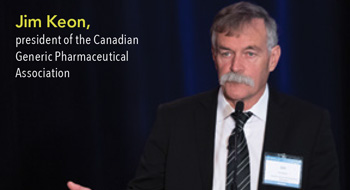
Jim Keon, president of the Canadian Generic Pharmaceutical Association, shared recent data with symposium attendees on the use of generic medicines in Canada and the falling costs of generic drugs. According to data from IMS Brogan and the Canadian Institute for Health Information (2012), Keon said, generic prescription drugs accounted for less than 3% (2.6%) of total health care spending ($217 billion) in Canada in 2011. “This is rather surprising in some ways, given the increased reliance everyone has on medications, and the fact that generics are now filling two-thirds of all prescriptions in Canada; yet, generic medicines still account for a very small percent of the overall healthcare spending in Canada,” he noted.
Keon pointed out that the price of generic drugs in Canada and in Alberta has declined dramatically—by 80%—between 2009 and 2014, despite an increase in the overall cost of living in Canada of 9.5% during these years. In 2013, Alberta spent $540 million on generic medicines. If there had only been brand-name drugs available, with no generics, the province’s drug bill would have risen by at least 75% to $1.5 billion, he suggested, adding that “overall price reductions in generic medicines have made both public and employer-sponsored drug programs viable.“
Canada has a highly regulated pricing market for prescription medicines. In 2014, more than 30% of generic drug sales in Canada are priced at a maximum of 18% of the brand name drug price; in 2006, generics on average were priced at about 65% of the brand. Prices have come down dramatically, resulting in substantial savings for public and private sector drug benefit plans, Keon explained.
The Canadian Generic Pharmaceutical Association has recently negotiated a three-year agreement with The Council of the Federation on a pricing model to introduce more predictability in drug spending and pricing levels, he said. The generic industry has agreed that Canada’s 18 most widely used generic drugs will all be priced at a maximum of 18% of the price of the brand-name version by 2016. “The savings you have today are going to grow and get larger over the next few years in a relatively predictable way,” he said.
Despite the potential savings to drug plans, the private sector lags behind public sector usage of generic drugs in Canada. In Alberta, for instance, about 64% of the 41 million prescriptions filled are generics; a little below the Canadian average of 66%. However, the public sector use of generic medicines in Alberta is at a much higher percentage (73%) of all prescriptions written than the private utilization of generics (56%). “This shows there is enormous opportunity for private sector drug plans to increase the use of generic drugs and to create capacity for spending in other areas of health benefits, like wellness and broader access to newer products,” said Keon.
Canada’s generic-usage rate of 66% is a far cry from the 86% generic-usage rate achieved in the United States, he stressed. “If the use of generic drugs in Canada increased to match the American levels, Canada’s healthcare system would have saved about $6 billion in 2013. It’s a tremendous amount of money. The generic is the same quality product at a much, much lower price. Why aren’t we taking advantage of the very dramatic savings that are clearly available to us? We calculate that if we increased the use of generic drugs in Canada, for every 1% increase, the savings would be $332,900,000. In Alberta, the savings would total $28,300,000 ($14,300,000 for the private sector).”
In conclusion, Keon stressed that the opportunities for enhancing drug benefit plan sustainability through the increased use of generic medicines have never been greater, and he encouraged attendees to take action to make the most of those opportunities.