

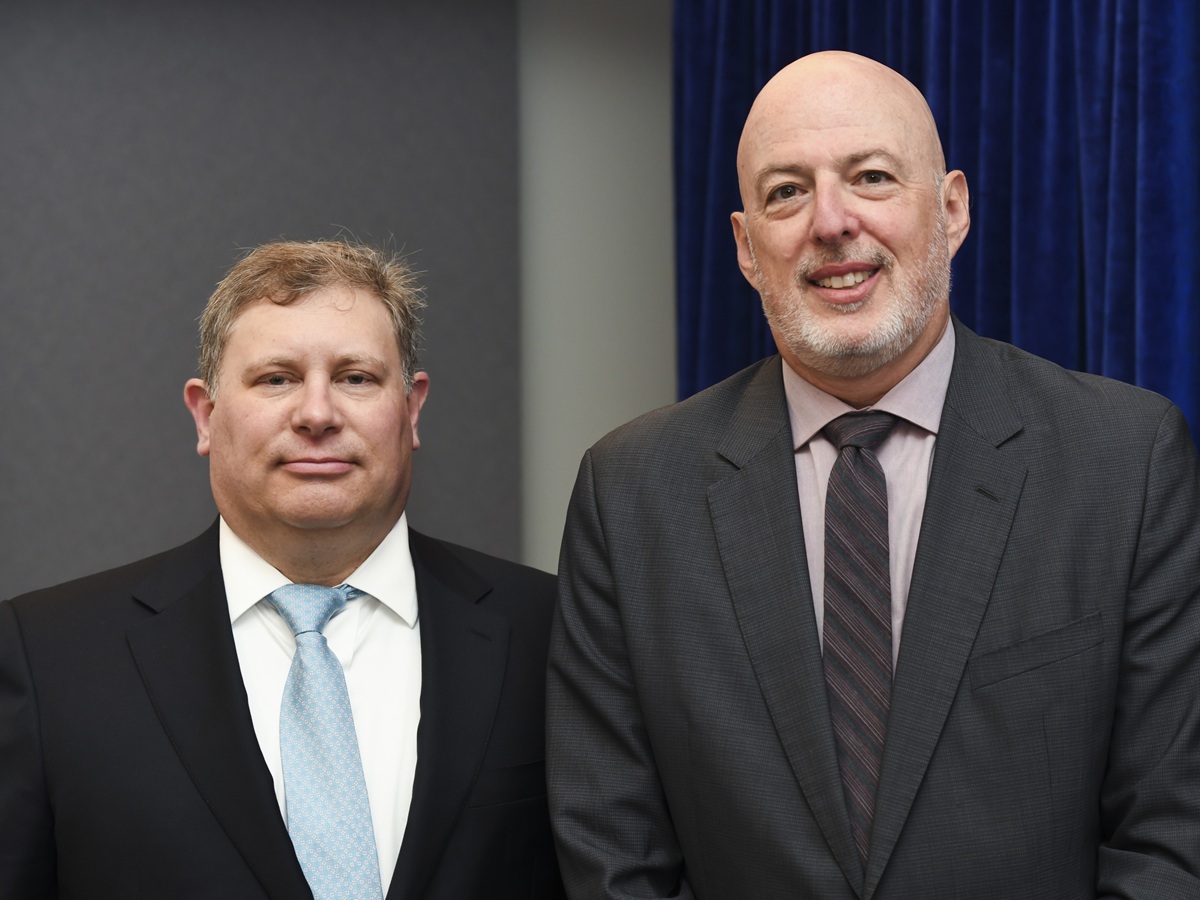
The Financial Services Regulatory Authority of Ontario is working to address the problems of a detailed compliance approach to pension regulation, said James Hoffner (pictured left), head of prudential supervision and large public sector pension plans at the FSRA, during the keynote session at the Canadian Investment Review’s 2025 Risk Management Conference.
A one-size-fits-all approach to regulation can leave gaps, since it won’t apply equally in all circumstances and will potentially become obsolete for some organizations, he said, noting this approach can also miss the mark if it isn’t outcomes-focused. “The result is round peg, square hole problems.”
Hoffner described the Pension Benefits Act as a hybrid legislation with prescriptive requirements and a standard of care mandate — reflecting a principles-based regulation approach. This is where Hoffner and Paul Martiniello (pictured right), head of prudential supervision and single- and multi-employer pension plans at the FSRA, focus their attention and supervision.
Read: FSRA outlines risk model to avoid pension plan investment turmoil, risks
“We are outcomes-focused, which ties into the FSRA’s statutory object of protecting benefits and being risk-based, which means we aim to be proactive in addressing risks before they materialize,” said Hoffner.
The approach is dictated by aiming to be proactive, transparent and collaborative, said Martiniello. The FSRA started employing principles-based regulation guidance in 2019, he added, with a focus on defined benefit, single-employer pension plans. The regulation was tested when it launched, right alongside the coronavirus pandemic, in March 2020.
The principles-based regulation model prioritizes collaboration with a proactive and transparent approach, he said, noting this thinking has also informed the FSRA’s revamped pension plan examinations process as part of its overall risk-based supervisory framework, which was published last year. “Our proactive, predictive and forward-looking approach to assessing risks has really become more robust,” said Martiniello. “Our response, which is always meant to be proportionate, has also become much more agile and efficient.”
Read: FSRA monitoring target-benefit framework, pension risks in 2025
The FSRA conducts its risk assessment quarterly, at a minimum, but it can also be completed anytime it’s deemed relevant. It applies to all DB plans, including single- and multi-employer pension plans, as well as defined contribution plans. The risk program includes ongoing monitoring of specific companies, different sectors and overall macro environmental and economic capital market conditions.
All the information is input into a digital system that provides an initial risk screening, that’s then used by the team, applied with their own judgement, to narrow which plans to review more closely, said Martiniello. “We are then able to come up with some form of action or activity and that’s what we call the dynamic approach to prudential supervision.”
Despite all this inputted information, there are still some gaps the FSRA fills by engaging directly with plan advisors — a critical part of the supervisory approach providing the regulator with key information to update the risk profile view of a plan — alongside investment consultants, actuaries or even lawyers, in some cases.
The FSRA wants to move away from a checklist risk management approach in favour of one that focuses on overall governance, said Martiniello. “Now we have a much more dynamic approach that has this focus on where we think the biggest risks are.”
Read more coverage of the 2025 Risk Management Conference.