

At Canada Pension Plan Investments, the willingness to change your mind after meaningful world changes is just as important as the conviction of the rigorous investment process, says Heather Tobin, the organization’s senior managing director and global head of capital markets and factor investing.
The pursuit of a highly diversified global portfolio requires multiple alpha engines across factors, strategies, geographies and implementation types, she adds. “When you’re allocating across a wide range of global strategies, alignment in your investment beliefs and portfolio design priorities is critical. It allows you to make decisions with conviction and hold yourself accountable for outcomes.”
Read: CPP Investments returns 0.5% in “volatile” Q3 2026
Getting to know Heather Tobin
Job title:
Senior managing director, global head of capital markets and factor investing, CPP Investments
Joined CPP Investments:
2009
Previous role:
Managing director, head of investment portfolio management, office of the chief investment officer, CPP Investments
What keeps her up at night:
The number of shifts in the macro landscape
Outside of the office she can be found:
Keeping up with a busy calendar full of social activities and sport schedules for her two kids
Last year, the impact of geopolitics on market performance reached a new frontier as institutional investors were pushed to evaluate the progress of allocations under an uncertain horizon. This environment is continuing to force investors to prioritize resiliency in their portfolios. For CPP Investments, that starts with diversification. Its pursuit at the fund level allows the organization to run neutral strategies to equity beta or other broad-based market factors, producing a return stream uncorrelated to other asset classes, says Tobin, noting the process helps smooth the fund’s return profile when the returns of other asset classes can be more volatile.
She credits the progress of global markets — particularly emerging market equities in 2025 — as a helpful relief in a context of increasingly concerning concentration risks from the U.S. equity space. Indeed, the continued interest in the biggest technology companies, alongside increased demand for artificial intelligence solutions, is driving the performance of the U.S. equity market.
That concentration risk is top of mind for Tobin. Diversification from the macro environment is essential for the fund, she adds, because concentration creates an environment with decreased dispersion and fewer performance leaders available.
Read: Concentration risks from AI trend putting pressure on long-term equities outlook: expert
“We’re mindful of the level of concentration in the U.S. equity market, just as we are with any source of portfolio risk. We’re thoughtful about not introducing undue concentration and it’s something we monitor closely.”
Tobin oversees the allocation of the investment organization’s active portfolio and ensuring the fund has a desirable combination of active investment strategies across its six investment departments. It invests across more than 60 external public market managers and hedge fund managers, while internally, it relies on a systemic strategies group to allocate more than a dozen strategies across global markets — global equities, commodities, credit, currency and fixed income.
A process based on internal tools and systems evaluates the performance, attribution, key market indicators and risk allocation across the portfolio. “I focus on tying together the threads and themes we’re seeing — both across the strategies we run and through our engagement with our external managers.”
Read: 2025 Investment Innovation Conference: How CPP Investments is balancing innovation and stability
For an organization as robust and layered as CPP Investments, the path for any investment trend or idea to become reality starts at the portfolio design stage, she adds. The investment team takes the parameters and performance targets within its risk to return profile and asks how it can design a portfolio to achieve the performance targets it requires.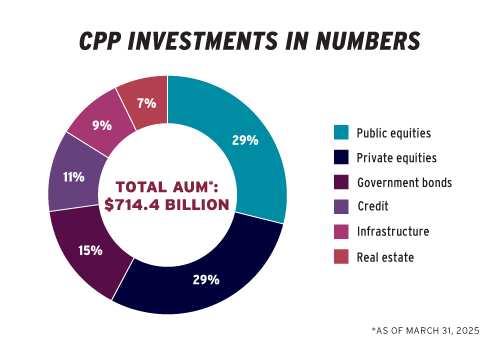
“Within each strategy, we understand the distribution of potential return outcomes over time, which directly informs our risk appetite,” says Tobin.
Currently, the fund has a high appetite for absolute return strategies because of their diversifying effect, she says. She also notes she’s motivated by the complexity of the challenges ahead and the scale of how the investment organization will go about navigating an environment that’s shown how quickly things can change. “It’s a highly dynamic and privileged place to be.”
Bryan McGovern is an associate editor at Benefits Canada and the Canadian Investment Review.