

In the OPSEU Pension Trust’s pursuit of strong retirement outcomes for members, the journey is just as important as the destination, says Jacky Chen, the organization’s managing director of completion portfolio strategies and total portfolio management.
“I think the key part is we think about risk as a scarce resource — and we must take risks to generate returns. . . . We have a mature pension plan and that means our funding profile is becoming more and more path-dependent. While the point of a long-term investor is to reach a good outcome [for members], how you get there also becomes more and more important.”
Getting to know Jacky Chen
Job title:
Managing director, completion portfolio strategies and total portfolio management, the OPTrust
Joined the OPTrust:
2017
Previous role:
Director, total fund quantitative strategies and capital markets, the OPTrust
What keeps him up at night:
How to adapt investment strategies amid evolving technology and data
Outside of the office he can be found:
Trying out recipes at home and checking out new restaurants
Read: OPTrust returns 4.2% in 2025, remains fully funded
When Chen joined the OPTrust in 2017, the investment organization was in the early phase of implementing its member-driven investing strategy, representing a shift away from a more traditional strategic asset allocation approach to a more liability-aware, total-fund focus framework. “Under this framework, we actually changed our overall risk metric; instead of just thinking about the assets, we also take into account the liability.”
The organization’s overall risk appetite is now defined by the funding risk, since it provides a measure of the plan’s sustainability, says Chen. “We look at funding risk and liquidity as the two major risk metrics in how we manage our day-to-day operations [and] in how we pay pension [benefits]. That’s kind of a deviation from more of a traditional asset manager-like investment approach.”
It’s a work in progress, with the OPTrust incorporating additional factors into its risk management process. “We are continuing to evolve this approach, potentially introducing more factors such as inflation and also thinking about foreign currency exposure.”
Read: OPTrust reduces financed emissions intensity by 11% compared to 2022: report
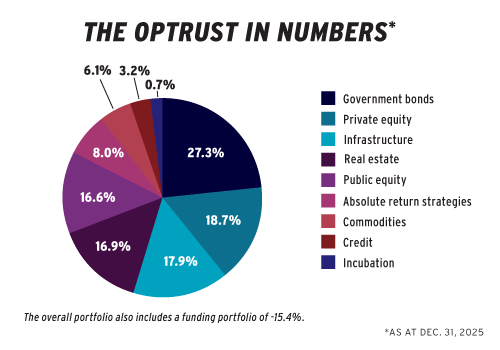
The organization’s illiquid assets — including exposure to private equity, infrastructure and real estate — is where the OPTrust believes it has the best long-term value creation opportunities, he says. “On the public side, we have this completion portfolio concept, which serves several purposes: liability and ethics, hedging, funding and liquidity management and maximizing total fund return with residual risk, which is really making sure we have the sufficient cash to meet any obligations and promises.”
Chen also manages the OPTrust’s systematic strategy, taking an evidence-based, data-driven approach to managing its various allocations and balancing the portfolio’s liquid and illiquid mix to achieve the desired risk appetite and returns.
As the strategy evolves, the organization is seeking increasingly granular data to inform its investment decisions in real time. “More and more, we are looking into alternative data — for example, real-time grocery price data that potentially reflects the macro condition.”
Read: OPTrust aiming to cut 30% of carbon footprint from portfolio by 2030
Chen is also an adjunct professor at the University of Toronto’s Rotman School of Management, a role in which he has conducted research on artificial intelligence. In 2020, the OPTrust introduced machine-learning techniques to aid its investment strategy, including identifying non-linear market patterns. It also uses AI to support the productivity of employees working on the portfolio.
“We wanted to make sure AI is there to help us to achieve our strategic plan . . . and we spend a lot of time defining business-use cases and training our people so they can use the tool productively,” he says. “Last year alone, we used AI to process around 11 million pages of investment documents — and that has certainly saved us time.”
Blake Wolfe is the managing editor of Benefits Canada and the Canadian Investment Review.