

More than half (56 per cent) of plan members say email is the most effective way to communicate with them about their savings plans, according to Benefits Canada’s 2026 Employee Savings Survey.
The survey, which polled 500 Canadian plan members, found traditional mail (18 per cent) was a distant second preferred communications tool, followed by an insurance company website (17 per cent) and a financial advisor meeting arranged by an insurance company (14 per cent).
During a webinar discussing the survey’s results, Jimmy Carbonneau, national director of group retirement, group insurance and group annuity plans advisor at AGA Benefit Solutions, said it was reassuring to see the predominant use of email alongside a decrease in alternative communications. “Communication depends on two things: consistency and relevance.”
Read: How social media is helping employers streamline, personalize pension communications
The survey also found social media was cited by more younger members (14 per cent for those aged 18 to 34) as an effective communications tool compared to their older counterparts (six per cent for those aged 35 to 54 and three per cent for those aged over 55-years-old).
Export Development Canada is meeting the demand for quick hit communications, according to Angela Rawal, its principal of pension programs. “We’re incorporating . . . brief reminders or touch points [into our communications plans] that surface during different parts of the pension savings and broader benefits offering over time.”
Carbonneau also noted younger plan members prefer piecemeal information that’s punchier. “Knowledge and communications are not [all] at once — it’s built over time.”
The survey also asked about people’s level of trust for information provided by an AI chatbot or robo-advisor through their workplace savings plan, with a fifth (19 per cent) saying they trust this information fully. Men (26 per cent) were twice as likely as women (13 per cent) to trust this information, while younger members were also more likely than their older counterparts.
Read: Men report more confidence, employer support for AI use than women: survey
Tawnya Duxbury, assistant vice-president of products and solutions for workplace retirement at the Canada Life Assurance Co., said women and older demographics prefer a human interaction before making financial decisions. “From the women standpoint, it’s largely more as a bouncing board to say, ‘Am I on the right track? Does this make sense?’ [With] more of that reassurance along the way.”
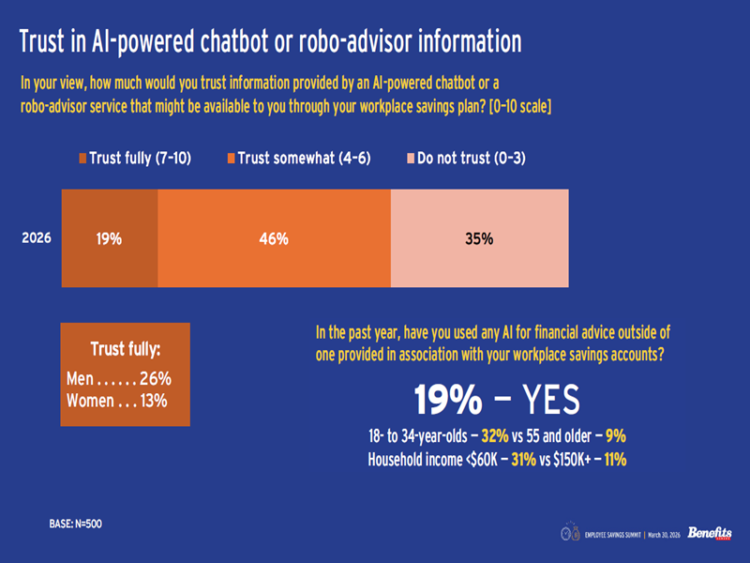
The technology isn’t playing a prominent role with investment information or advice yet. The survey also found a significant majority (81 per cent) of plan members said they haven’t used AI for financial advice outside of their workplace savings plans. Its use was highest among young respondents — 32 per cent among those aged 18 to 34 compared to nine per cent among their oldest counterparts. As well, those in the lowest income group (less than $60,000) were the most likely (31 per cent) to have used AI for financial advice.
Read: AI supporting, but not replacing, pension, benefits teams: experts
Highlighting the 19 per cent of respondents who reported using AI for financial advice outside of their workplace, Dean Newell, vice-president at Actuarial Solutions Inc., said it shows a measured and responsible experimentation with the technology.
“It’s important to distinguish between whether folks are using AI for information or advice. While they may use AI tools to learn, explore scenarios [and] build stronger understanding, people may be far less willing to rely solely on AI as the source of advice for major financial decisions.”
Among respondents who reported using AI in an investment environment, 86 per cent said they were satisfied, while 15 per cent weren’t entirely happy with the results.
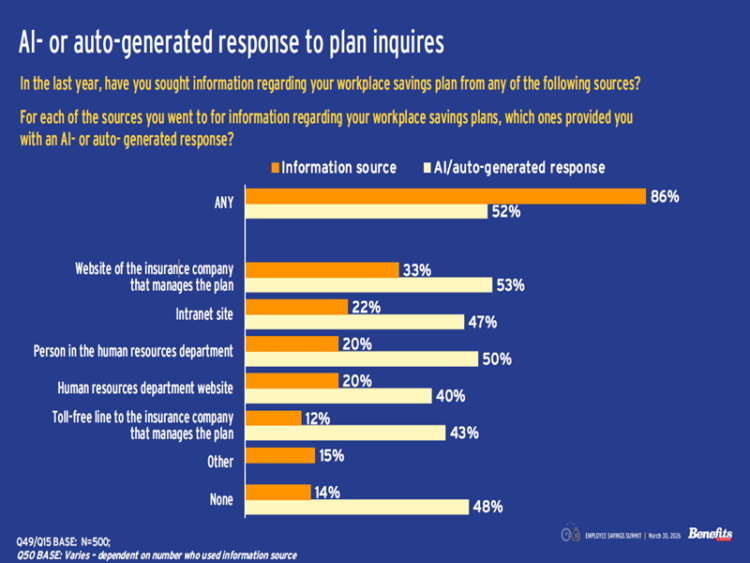
Employers are facing a novel challenge, said Duxbury, since employees are forming impressions of pension and savings plans based on summaries or explanations created by AI tools, said Duxbury. “If you’ve made major changes to your pension or savings plans and those materials on the old version of the plans are still out there, AI tools will still reference them. You just need to be really careful of that.”
Indeed, it’s important for plan sponsors to consider how their employees may use AI in the context of financial or retirement planning, added Rawal. “That has really helped us think about communication quality, so we’re going to be even more focused on keeping our internal websites, plan documents and reference materials clear, current and consistent, because those materials would be the baseline that employees — and AI — draws from when interpreting how our plans work.”
Read more coverage of the 2026 Employee Savings Summit here.