
As millennials become a dominant demographic in Canadian workplaces, employers are rethinking how they communicate their savings plans.
Indeed, that shift is reshaping how EllisDon approaches communications and engagement with its savings program, says Marie-Lynn Bromilow, the construction services company’s vice-president of total rewards, noting millennials make up a significant portion of its plan membership.
It offers employees a defined contribution pension plan with a 50 per cent employer match in the first year and a 100 per cent match in subsequent years. For Bromilow, helping employees understand how the plan works is just as important as the design of the program itself. “Over the last few years, we’ve really put a large focus on helping employees build financial literacy.”
In addition, understanding how employees interact with the plan is central to the company’s strategy, she adds. “We analyze a wide range of data to gain insights into participation rates and how our employees are engaging with their programs.”
To track this data, EllisDon uses dashboards, quarterly reporting and annual plan reviews. “Assessing engagement, participation rates, contribution levels, investment behaviour and life stages of our employees allows us to gain insights about employee interaction with our savings plan,” says Bromilow.
In addition, the organization reviews that data to adjust how it communicates with different employee groups, including millennials. “We value our employees’ feedback — what employees like, what they don’t and what challenges they’re experiencing.”
It also uses its employee engagement surveys to gain insight into how plan members view the company’s total rewards programs and where communication can improve. According to Bromilow, these insights have helped shape how the organization communicates about its savings programs and its financial wellness initiatives.
Generational insights
EllisDon isn’t the only plan sponsor using data to explore how different generations interact with their savings programs.
“Plan sponsors are using data to understand what different employee groups need and how they like to engage,” says Hilda Tang, senior vice-president of client growth and solutions in group retirement services at Sun Life Financial Inc.
Read: 2026 Employee Savings Survey: A demographic deep dive into the state of workplace savings
Insights such as participation data, contribution patterns and engagement metrics can highlight where employees may not be taking full advantage of their plans, she adds. “From there, [plan sponsors] can run targeted education sessions and tailor communications so they’re more relevant and more likely to prompt action.”
Younger employees often approach retirement savings differently than previous generations, she notes. “Millennials and gen Z are often thinking about day-to-day financial resilience and flexibility.”
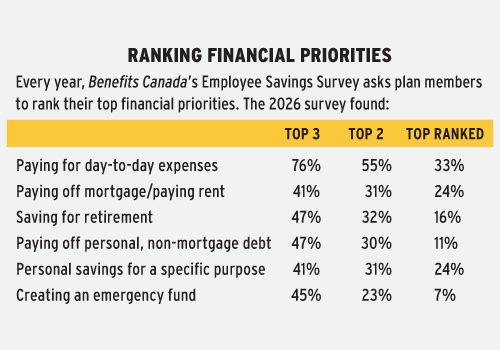
As well, housing costs, student debt and other financial pressures can influence how younger employees view long-term savings, she adds. “For many early-career employees, retirement can feel abstract. Education helps them understand how workplace savings plans can support broader financial goals.”
At EllisDon, these financial realities often come up during conversations with employees. “We hear directly from employees about the financial pressures they’re facing and the questions they have about saving.”
Read: Survey finds confidence key to higher retirement savings
Part of that conversation is helping employees understand how workplace savings plans can support both long-term retirement goals and shorter-term financial priorities. “For example, a portion of [registered retirement savings plans] savings can be used for a first home purchase through the Home Buyers’ Plan or for education through the Lifelong Learning Plan,” says Tang.
Driving engagement with communications strategies
Education sessions have become a central part of EllisDon’s communications strategy.
It introduced total rewards roadshows that provide employees with an opportunity to learn more about the organization’s savings programs and ask questions about how the plans work. “It’s been helpful because we’re having more candid conversations with employees about our programs,” says Bromilow, noting the sessions help employees better understand how their contributions grow and how the employer match supports long-term savings.
Many plan sponsors are exploring more flexible savings plan structures, says Tang. “For example, some sponsors allow members to direct contributions to different savings vehicles such as a defined contribution pension plan, an RRSP or a tax-free savings account while maintaining the employer match.”
Read: 80% of employees want financial education at work: survey
She also points to digital engagement as an increasingly important factor in retirement outcomes. According to Sun Life’s member data, digitally engaged members have average account balances of about $123,800, compared to $51,800 among members who aren’t digitally engaged. They also contribute about 61 per cent more to their savings accounts and are twice as likely to maximize their employer matching contributions.
EllisDon introduced online enrolment tools that allow employees to manage their savings and make adjustments as their financial situations change. “With the rollout of online enrolment, employees can make changes much more easily. When things become more accessible, we see greater participation in plans.”
The organization’s ultimate goal is helping employees understand how workplace savings programs support their broader financial well-being. “When employees understand what’s available to them and how it supports their financial goals, they’re much more likely to participate.”
Sonya Singh is an associate editor at Benefits Canada and the Canadian Investment Review.